I was 17 when Parkinson’s started changing my body. It took me years to understand that it didn’t have to define my life.
I was a teenager when I first noticed something wasn’t right.
It started with a tremor in my left foot. My body was beginning to do things I couldn’t explain. I had already lost my sense of smell years earlier, although at the time I had no idea that could mean anything.
I was young. I was an athlete. Parkinson’s disease wasn’t even on my radar.
For years, I lived without knowing what was actually happening inside my body. I was initially diagnosed with essential tremor, but the symptoms continued.
So did my life.
I went to college. I became a school psychologist. I coached swimming. I played hockey. I swam, snowboarded, ran and worked out.
From the outside, I probably looked like any other young guy trying to build a life.
But my body was telling a different story.
At 29, I finally got an answer:
Parkinson’s disease.
There is something strange about hearing those words when you’re not even 30.
Parkinson’s is a disease most people associate with someone much older. I didn’t look like the picture of Parkinson’s I had in my head.
But there I was.
Eventually, Parkinson’s became even more personal when my younger brother, Matthew, was diagnosed too.
Two brothers.
Both young.
Both living with Parkinson’s.
Same disease. Different journeys.
What Parkinson’s Really Looks Like
I’ve now been experiencing symptoms for roughly two decades.
And Parkinson’s is no longer something I can easily hide.
There are tremors, rigidity and dystonia. There are times when my toes curl or my muscles tighten. There are periods of dyskinesia when my body moves excessively and I can’t simply tell it to stop.
There are ON times when my medication is working.
There are OFF times when it isn’t.
There is fatigue.
There are sleepless nights.
There are days when something that should be simple suddenly isn’t.
And there is the constant calculation that comes with Parkinson’s:
When did I take my medication?
When is my next dose?
Will it kick in?
How long will it last?
What will my body allow me to do today?
That’s the part people don’t always see.
Social media can show the hockey games, swimming, snowboarding, smiles and accomplishments.
But it doesn’t always show what happens before or after those moments.
It doesn’t show the waiting for medication to kick in.
It doesn’t show the frustration when my mind knows exactly what it wants my body to do, but my body has other plans.
It doesn’t show the energy it sometimes takes just to appear “normal.”
I don’t share those parts of my life because I want people to feel sorry for me.
I share them because this is Parkinson’s too.
But This Is Also My Life
For a long time, I thought strength meant proving that Parkinson’s couldn’t stop me.
If I could still play hockey, I would play hockey.
If I could still swim, I would swim.
If I could still snowboard, I would snowboard.
Keep moving. Keep pushing. Keep proving.
But over time, I’ve started to understand something different.
Living fully isn’t about pretending Parkinson’s doesn’t affect me.
It does.
Living fully is choosing not to surrender everything else about myself to it.
I’m a school psychologist.
I’m a husband.
I’m a brother.
I’m an athlete.
I’m an advocate.
I’m a friend.
I’m someone who loves getting onto the ice, being in the water, heading to the mountains and finding out what my body can still do.
And yes,
I am someone living with Parkinson’s.
All of those things can be true at the same time.
Why I Keep Taking the Ice
Hockey has always meant something special to me.
When I’m on the ice, I’m not thinking about being “the guy with Parkinson’s.”
I’m trying to make the next play.
I’m competing.
I’m laughing.
I’m living.
Parkinson’s has changed the way I move, but it hasn’t taken away my desire to move.
Every time I lace up my skates, I’m reminded that there are still things my body can do and experiences this disease doesn’t get to take from me.
I don’t know how many more games I’ll get to play.
But none of us really know how long we’ll get to do the things we love.
So while I can still take the ice, I will.
The Next Chapter
My Parkinson’s has progressed.
After years of medications and increasingly difficult motor fluctuations, I’ve reached another major point in my journey: Deep Brain Stimulation, or DBS.
As part of my evaluation, my Parkinson’s symptoms were measured after being off medication and then again after taking it.
My symptoms improved by more than 60 percent with medication.
I was approved for DBS.
That was a big moment for me.
But DBS isn’t a cure for Parkinson’s.
I’m not going into surgery expecting Parkinson’s to disappear.
I’m going into it hoping for something much simpler and much more meaningful:
More good time.
More control over my body.
More time doing the things I love.
More time on the ice.
More time in the water.
More time with the people I love.
More life.
More Than
Living with Parkinson’s for this long has made me think a lot about identity.
When you live with a disease long enough, it can slowly start attaching itself to everything.
People know you as the person with Parkinson’s.
Appointments revolve around Parkinson’s.
Medication revolves around Parkinson’s.
Your plans sometimes revolve around Parkinson’s.
Even telling your own story can start revolving around Parkinson’s.
But somewhere along the way, I realized something:
Parkinson’s is part of my story. It isn’t the whole story.
That realization became something I call MORE THAN.
MORE THAN PARKINSON’S isn’t about pretending Parkinson’s doesn’t exist.
It isn’t about being positive every second.
It isn’t about pretending the hard days aren’t hard.
And it certainly isn’t about being stronger than everyone else.
It’s about refusing to reduce a human being to the hardest thing they’re facing.
I have Parkinson’s.
But I am more than Parkinson’s.
And you don’t need Parkinson’s for that message to belong to you.
Maybe what you’re facing is cancer.
Grief.
Depression.
Disability.
Loss.
Failure.
Fear.
Or maybe you’re going through something nobody else even knows about.
Whatever it is, I hope my story reminds you that the hardest chapter of your life does not have to become the title of your entire story.
I’m still figuring out what comes next.
Parkinson’s is progressing.
DBS is ahead of me.
There will be good days and difficult ones.
There are no guarantees.
But tomorrow was never guaranteed for any of us.
So I’m going to keep showing up.
I’m going to keep stepping onto the ice when I can.
I’m going to keep getting in the water.
I’m going to keep heading to the mountains.
I’m going to keep serving kids and families through my work.
I’m going to keep telling the truth about Parkinson’s, the difficult parts and the beautiful parts.
I’m going to keep advocating for better treatments and, hopefully someday, a cure.
And most importantly, I’m going to keep living.
Because after nearly two decades of Parkinson’s changing my body, I’ve learned that it doesn’t get to decide the entirety of who I am.
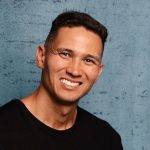
My name is Michael Lu.
I have Parkinson’s.
But I am more than Parkinson’s.
And whatever you’re facing,
you are more than that, too.