
“Do you have any questions?”
Questions?! I’m not even sure what Parkinson’s is, let alone know what questions to ask. Yes, I have one:
“Can I still be a mom?”
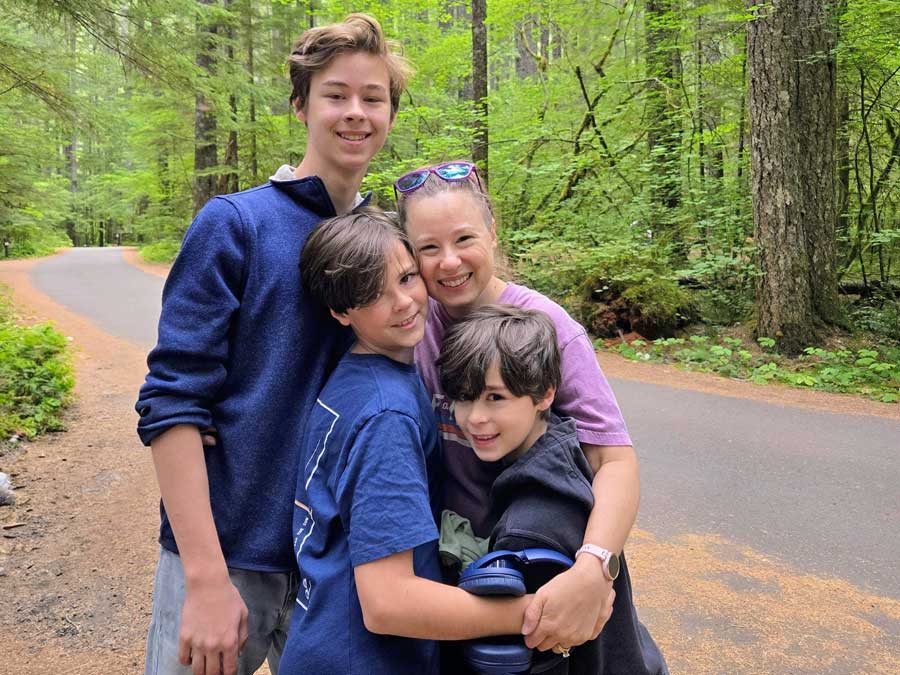
I was 34 years old with three young boys, ages 1, 3, and 6, when I heard the dreaded words: “It’s Parkinson’s.”
Everything went silent, and tunnel vision set in. I was watching, in real time, my future being derailed. How was I going to manage marriage and parenthood with Parkinson’s? Would we still have the life we dreamed of? Would I be capable of being a parent? How do I raise my boys while I have a neurodegenerative disease? What would they think?
I was alone. There was no one I knew who could remotely relate to what I was going through. I reached out to many places asking for help. While support was available in some ways, there was nothing to help a young woman with Parkinson’s navigate parenthood.
You enter motherhood with some idea of what kind of mom you want to be and how you want to raise your children. Motherhood is hard enough, and then you throw Parkinson’s on top of it. I no longer had the energy to push the swings. I became overwhelmed by too much noise or chaos. I fought apathy. I wanted to want to play with them.
Then the guilt set in. This isn’t fair to them. They didn’t ask for this. They deserve to have fun, to play outside all day, to go on new adventures, and to have a mommy who is running alongside them.
One night, they watched me take my medication, and the question was asked:
“Why do you need your medicine?”
I explained the best I could.
“The medicine I swallow helps my brain tell my body to stop shaking. You know when Mommy’s body shakes? The medicine helps it stop.”
All of a sudden, I started crying. I guess explaining why I needed my pills to my 6-year-old was more emotional than I was prepared for. Explaining that Mommy didn’t just need this medicine for now, but Mommy needs it forever. Mommy needs it to function. Mommy needs it to be a mommy. All the while, I lay in bed not feeling like a very good mommy.
But with time comes education, understanding, and wisdom.
I learned, as all parents do, that there is no such thing as a perfect parent. What matters most is love and being present.
Because of Parkinson’s, I am able to show my boys things I might never have otherwise taught them: what strength and determination look like; what love, support, and companionship look like; how to get back up after a fall and do it with a smile and a laugh.
I am teaching them to find joy in all things. I am teaching them that while you may not be able to control a situation, you can control how you respond to it.
These gifts are more valuable than any playground session they may have missed.
I may not be the mother I had planned to be, but I will be the mother I am meant to be.